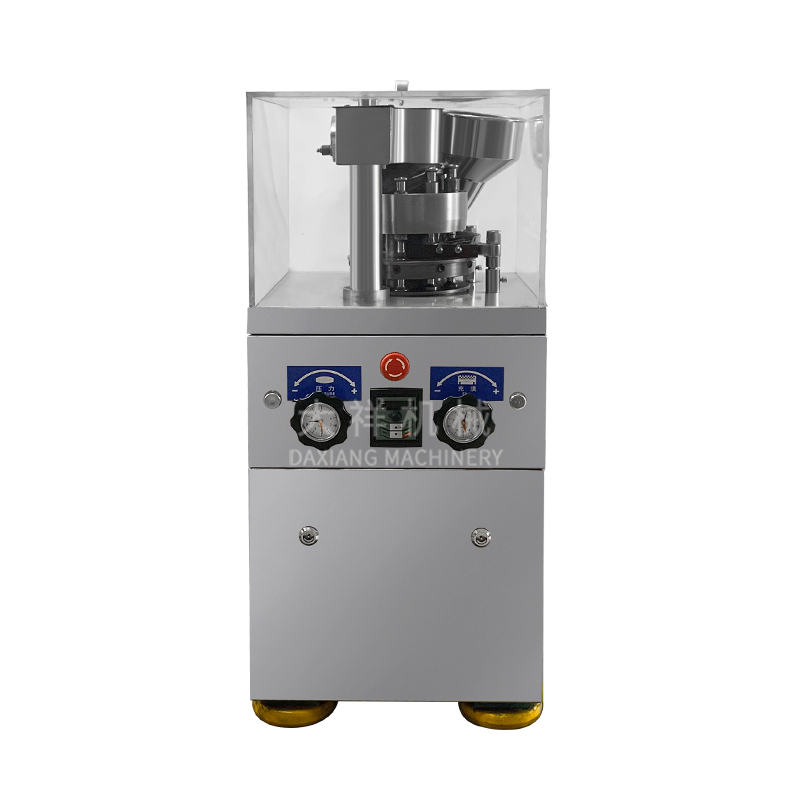
When it comes to pharmaceutical manufacturing, a high-speed rotary tablet press—such as those developed by PTK—is an essential piece of equipment. These machines are engineered to compress granular powder mixtures into uniform tablets for medicines and supplements with exceptional speed and consistent quality control. For companies looking to expand production or source reliable machinery, choosing the right Tablet Press Machine configuration is vital for long-term growth. Below, we break down how to evaluate a rotary tablet press and how to optimize your machinery investment.
Selecting the right tablet press relies heavily on your specific solid-dosage requirements. First, evaluate the target geometry of your formulations; while standard round tablets are straightforward, complex oval or multi-segment shapes require precise punch alignment and specialized tooling. DAXIANG provides technical guidance and compatible Rotary Tablet Press Machine options designed to accommodate various tablet profiles and depths. Next, consider your target output volume per shift. High-capacity manufacturing requires heavy-duty automated presses featuring advanced multi-station turrets to maintain velocity without sacrificing dwell time. Features like automated weight control, pre-compression steps, and user-friendly human-machine interfaces (HMI) greatly simplify calibration. Mechanical durability and ease of maintenance are equally critical; sourcing a machine constructed from robust, pharmaceutical-grade materials minimizes downtime and long-term repair costs. Balancing these performance factors against your capital expenditure ensures you secure a press that integrates seamlessly into your manufacturing line.
Sourcing reliable Tableting machinery within a target budget requires a strategic approach. Start by exploring trusted industrial equipment suppliers and platforms online. Manufacturers often provide tiered pricing or volume discounts on multi-station tooling and spare parts kits when purchasing equipment. Contacting suppliers directly can open doors to custom configurations, warranty extensions, or corporate promotions. Attending international pharmaceutical technology trade shows and exhibitions is another excellent way to evaluate machinery performance firsthand and negotiate directly with engineering teams. For facilities operating on leaner initial capital, exploring factory-certified refurbished models can provide high-level mechanical performance at a lower price point, provided the units come with verified maintenance logs and operational warranties. Comparing technical specifications and support agreements across suppliers will help you secure a cost-effective solution without compromising on production quality.
The primary advantage of implementing advanced rotary tablet press technology is the massive optimization of your production yield. These Powder Tablet Press Machine leverage continuous rotation and synchronized punch movements to deliver high-output manufacturing. A key benefit is operational precision; an engineered force-feeding system ensures that each die cavity receives an identical volumetric fill, maintaining strict weight uniformity and active pharmaceutical ingredient (API) dosing accuracy. Furthermore, modern control systems feature quick-adjust mechanisms, allowing operators to safely manage compression forces and fill depths on the fly. Built with industrial-grade stainless steel frames and hardened steel tracks, these systems are designed to withstand continuous high-pressure cycles, lowering your total cost of ownership. The flexibility to swap out turret heads or tooling sets also allows a single press to handle a diverse product portfolio, giving your facility the agility to adapt to changing market demands.
Even with robust machinery, mechanical variances can occasionally occur during continuous Tableting campaigns. A frequent issue is structural tablet defects, such as capping or soft cores, which usually indicate incorrect compression force settings or improper moisture content in the powder granulation. Operators can resolve this by adjusting the pre-compression rollers or recalibrating the formulation blend. Material jams within the feed shoe or die table can also halt production; these are typically caused by cohesive powders or insufficient cleaning. Implementing a strict clean-in-place (CIP) routine and keeping the product pathways free of dust buildup will prevent these clogs. Additionally, if the machine begins generating unusual noise or vibration, it often signals worn cam tracks or a need for mechanical lubrication. Routine preventative maintenance, regular die inspections, and proper lubrication are essential to keeping your tablet press running efficiently and avoiding costly production delays.
To improve customer satisfaction, the company offers a blister seal year warranty that includes lifetime maintenance as well as remote video or online assistance.
Guangzhou Daxiang is a manufacturer with a production facility which covers 3 000 square meters and storage space of Blister packaging machine square meters we have complete equipment models and sufficient spare parts to satisfy the needs of our customers this machine is extensively used in the packaging and pharmaceutical industries
The primary products of the company are Capsule filing machine, Blister Packaging Machine, Tablet Press Machine, Granule Powder Packaging Machine, manual blister packing machine, Tablet Counting Machine, Pill Making Machine Coating Machine, Pulverizer Machine and many more.
Blister packing machine logistics firms are skilled in a variety of transport methods. They can move items to different regions of the world swiftly, safely efficiently and effectively. We offer services to over 300.000 customers around the world and export to over 100 countries.

Slicer,crusher,pellet machine,tablet press,pill making machine,medicine decocting machine,mixing machine,coating machine,capsule filling machine,aluminum-plastic packaging machine,powder/particle/tea bag packaging machine,pillow packaging machine,heat shrink packaging machine,three-dimensional packaging machine,wet towel packaging machine,Abe wire drawing machine,vacuum packaging machine,drying box,etc...
No.151, Kuipeng Road, Kuipeng Village, Liwan District, Guangzhou, China
Copyright © Guangzhou Daxiang Electronic Machinery Co.,Ltd All Rights Reserved Privacy Policy
 EN
EN
 AR
AR
 BG
BG
 HR
HR
 CS
CS
 DA
DA
 NL
NL
 FI
FI
 FR
FR
 DE
DE
 EL
EL
 IT
IT
 KO
KO
 NO
NO
 PL
PL
 PT
PT
 RO
RO
 RU
RU
 ES
ES
 SV
SV
 TL
TL
 IW
IW
 ID
ID
 LV
LV
 SR
SR
 SL
SL
 UK
UK
 VI
VI
 HU
HU
 TH
TH
 TR
TR
 FA
FA
 AF
AF
 MS
MS
 GA
GA
 BE
BE
 IS
IS
 HY
HY
 BN
BN
 LO
LO